English Grammar

Table of contents
- Indefinite Articles “a” and “an”
- Plural
- The Definite Article “the”
- Countable and Uncountable Nouns
- Demonstrative pronouns "This", "That", "These" and "Those"
- The time
- Ordinal numbers
- The imperative
- The Saxon genitive
- Personal pronouns in English
- Possessive adjectives in English
- Possessive pronouns in English
- Reflexive Pronouns
- Practice with AI
- Introduction to Verb Tenses
- Simple Tenses
- Continuous Tenses
- Perfect Tenses
- The verb "to be"
- The verb "to have"
- Other verbs
- Glossary
- Author's Note
I recently decided to finish my English language studies and earn a certification. It's been over three years since I last studied English, and most of what I know now is programming terminology.
I've started studying English grammar on my own, and this post will bring those notes together. I'll add five new topics each week, with links to online exercises.
My goal is to put together a complete guide that makes concepts easier to understand, even when they can be confusing in a classroom.
Indefinite Articles “a” and “an”
Spanish meaning
| Indefinite Article | Spanish meaning |
|---|---|
| a | un / una |
| an | un / una |
When to use "a" or "an"?
The meaning is the same; the difference is that we will use "a" when the word begins with a consonant sound and "an" when the pronunciation begins with a vowel sound.
| Indefinite Article | Use | Examples |
|---|---|---|
| a | It is used before words that begin with a consonant sound. | a dog, a car, a university ("university" begins with the sound "yu", a consonant "y" sound) |
| an | It is used before words that begin with a vowel sound. | an apple, an elephant, an hour |
Watch out for the "h"
If the word begins with "h", the indefinite article to be used will vary depending on the pronunciation.
| Condition | Indefinite Article | Examples |
|---|---|---|
| "h" is pronounced | We will use "a" | a house, a hospital |
| "h" is not pronounced | We'll use "an" | an honest man, an hour, an honor |
Here are some words where the "h" is silent:
- honest
- honorable
- hour
- heir
- herb
- honor
When Not to Use the Indefinite Article
- Do not use a or an with uncountable nouns.
- Not used with plural nouns
Note: We can already see the importance of learning and practicing word pronunciation, which will come up throughout most of these topics.
Exercises
🔗 The Indefinite Article : English exercise.
🔗 Articles – Open Access Exercise
🔗 Indefinite Articles: A or An? - English grammar exercises
Plural
There are a few rules we can use to quickly know the plural of most words:
| Condition | Rule | Example |
|---|---|---|
| Words ending in "s, ss, x, ch, sh, z" | Add "es" | class > classes |
| Consonant + "y" | Change "y" to "i" and add "es" | city > cities |
| Words ending in "f" or "fe" | The ending is removed and "ves" is added | knife > knives |
| Words that end in "o" | They are generally converted to the plural by adding "es" | potato > potatoes |
Irregular plurals
There are also irregular words that do not follow the rules above. Some examples are:
| Singular | Plural |
|---|---|
| mouse | mice |
| scarf | scarves, scarfs |
| man | men |
| woman | women |
| person | people ("persons", in official documents) |
Exercises
🔗 Noun Plural - English Grammar Exercises
The Definite Article “the”
Spanish meaning
the => el / la / los / las
When to Use “the”
| Use Case | Example |
|---|---|
| Countable nouns | The book on the table is mine |
| Refer to something already mentioned | I saw a dog. The dog was very friendly |
| Talking about something or someone at the moment we identify it | Close the door, please |
| Before the proper name of a sea, river, archipelago or mountain range | The Pacific Ocean, the Nile, the Bahamas, the Andes |
| Before a singular noun that designates a class of animals or things | The lion is a strong animal |
| When it accompanies non-countable nouns without talking about them generically, but referring to a specific object | The water in this bottle is cold |
| For family names, by adding an "s" to the end of the last name | The Spencers |
| Countries that are plural or start with an adjective | The Netherlands, The United States, The United Kingdom |
| With compass directions when the preposition "of" is used | The north of Mexico is very dry |
When Not to Use “the”
| When not to use "the" | Example |
|---|---|
| Usually with non-countable nouns | Milk is a very common food |
| When using an uncountable noun in a general sense | Water is essential for life |
| With academic subjects, since they are uncountable and therefore do not require the definite article | She studies Math and Biology |
| Before country names in general | Spain, Mexico, Japan |
| With the cardinal points | Birds migrate south in winter |
| When a plural noun indicates an object generically | Cats are independent animals |
Pronunciation
| Condition | Pronunciation | Example |
|---|---|---|
| The + a word that begins with a consonant sound | /ðə/ (daa) | the car, the dog, the book |
| The + a word that begins with a vowel sound | /ðiː/ (dii) | the apple, the elephant, the hour |
| When you want to emphasize something | /ðiː/ (dii) | this is the (dii) best day ever! |
Exercises
🔗 The Definite Article : English Exercise.
🔗 The Definite Article 2 : English Exercise.
Countable and Uncountable Nouns
Within the English language we can differentiate two types of nouns, countable and non-countable:
- water: not countable, you can't say "one water", "two waters"...
- house: countable, you can say "one house", "two houses"...
Key Differences
| Countable nouns | Uncountable nouns | Example |
|---|---|---|
| They have plural forms | They do not have plural forms | house > houses / water > *waters |
| They can be used with the indefinite article (a/an) | They do not use the indefinite article (a/an) | a hause / *a water |
| - | They always take a singular verb | water is good > el agua es buena; "is" is the singular of the verb tobe |
Examples of Uncountable Nouns
- wine
- water
- milk
- beer
- cheese
- fruit
Turning Uncountable Nouns into Countable Nouns
Many non-countable nouns can sometimes become countable nouns. However, their meaning changes:
- "wine" (non-countable noun) => wine is red
- "wine" (countable noun) => Sherry is a wine from Spain
In the second case, wine indicates a type of wine, not wine in general
- "hair" (countable noun) => hair / hairs means "pelo / pelos" in Spanish and refers to one or more individual hairs
- "hair" (uncountable noun) => refers to "cabello" in Spanish
Physical discomfort
Words for physical discomfort are compound words that end in "ache"
In Great Britain, the following are non-countable:
- I've got headache => tengo dolor de cabeza
In the United States, the following are considered countable nouns:
- I've got a headache => tengo dolor de cabeza
Demonstrative pronouns "This", "That", "These" and "Those"
| Pronoun | Spanish meaning |
|---|---|
| This | Este, esta, esto |
| That | Esa, esa, eso, aquel, aquella |
| These | Estos, estas |
| Those | Esos, esas, aquellas, aquellos |
That is a table > That's a table (more colloquial form)
Determiner
Demonstrative pronouns also function as determiners:
- Pronoun: replaces the noun => My opinion is this
- Determiner: accompanies the noun => I'm tired of these jeans
Exercises
🔗 Demonstrative Pronouns : English exercise.
🔗 Exercises: Demonstrative pronouns
The time
Key Concepts
| En punto | o’clock |
| Cuarto | quarter |
| Y media | half past |
| For minutes within the first half hour | past |
| For minutes within the second half hour | to |
| Medianoche | midnight |
| Mediodía | noon |
| AM and PM | They are used the same way as in Spanish |
Examples
| It's five past ten | Son las diez con cinco |
| It's ten past eleven | Son las once y diez |
| It's twenty-five to four | Son las cuatro menos veinticinco |
| It's quarter to seven | Son las siete menos cuarto |
| It's half past two | Son las dos y media |
| It's twelve o'clock | Son las doce en punto |
| It's one to twelve | Es un minuto para las doce |
| It's midnight | Es medianoche |
| It's noon | Es mediodía |
Colloquial form
An easier and more colloquial way to tell the time is to read it as it appears on a digital clock:
| Six twenty | Las seis veinte |
| Eight thirty | Las ocho y media |
| Ten fifty | Las diez con cincuenta |
Notes
- To ask the time we can say: "What time is it?"
- An easy way to remember past and to is with the Spanish word "pasto":
- past → first half of the hour
- to → second half
Exercises
🔗 The Time – Free Access Exercise
🔗 Exercise 1 - The time in English
Ordinal numbers
Rules
| Add "th" to the cardinal number | four → fourth |
| Tens change the final "y" to "ie" before adding "th" | twenty → twentieth |
| When writing ordinal numbers as numerals, add the last two letters of the written form | one hundred and forty-second → 142nd |
Exceptions
Exceptions are like irregular verbs: there is no rule or pattern, so you just have to learn them.
| Primero | first |
| Segundo | second |
| Tercero | third |
| Quinto | fifth |
| Octavo | eighth |
| Noveno | ninth |
| Duodécimo | twelfth |
Exercises
🔗 Ordinal Numbers : English exercise.
🔗 Ordinal numbers – Free exercise
The imperative
Generally, the imperative has the same form as the infinitive (to + verb), but without the "to".
Uses
| Give orders | Turn the lights on! → ¡Enciende las luces! |
|---|---|
| Give instructions or directions | urn right at the traffic light. → Gira a la derecha en el semáforo. |
Negative form
It is formed with don't + verb.
Example:
Don't do it! → ¡No lo hagas!
Emphasize More
To reinforce the imperative, the verb must be preceded by "do". This expresses emphasis or irritation.
Example:
Do turn it off! → ¡¡Apágalo!!
Use in instructions
When the imperative is used to give instructions, the verb can be in its infinitive form with "to", especially in educational or explanatory contexts.
Examples:
Listen to these words. → Escucha estas palabras.
Try to pronounce this word. → Intenta pronunciar esta palabra.
Exercises
🔗 Imperative Sentences : English exercise.
🔗 Imperative Sentences 2 : English exercise.
The Saxon genitive
The Saxon genitive is used to denote possession in the following cases:
- People
- Pets
- Countries
- Expressions of time, space, or distance
- Sometimes, for cars and boats
It is also used with collective nouns that refer to organizations, companies or institutions, especially when referring to the people who work in them.
Examples:
- The hospital's room → La habitación del hospital
- The company's director → El director de la compañía
Structure
Possessor's name + 's + name of the object possessed
Examples:
- Susan's book → El libro de Susan
- Tom's grandmother → La abuela de Tom
Nouns ending in "s"
When the noun is plural and ends in "s", only the apostrophe (') is added.
Example:
- Two minutes' walk → Un paseo de dos minutos
Use in Time Expressions
Example:
- Have you got today's paper? → ¿Tienes el periódico de hoy?
Double Possessive
When there are two possessives (double Saxon genitive), the word order is reversed compared with Spanish.
Examples:
- This is John's mother's car. → Este es el coche de la madre de John
- Take Emily's sister's book, please. → Toma el libro de la hermana de Emily, por favor
Difference Between British and American English
The main difference lies in the use with collective nouns (restaurants, shops, schools, churches, etc.):
- British: requires the Saxon genitive with an apostrophe and "s". → St. Mary's School
- American: leaves the name unchanged, since possession is implied. → St. Mary School
Exercises
🔗 Exercise 1 - Saxon genitive in English - 1st ESO - Online English exercises
Personal pronouns in English
Subject pronouns
They are used to indicate who performs the action of the verb.
| Subject pronoun | Spanish meaning |
|---|---|
| I | Yo |
| You | Tú |
| He | Él |
| She | Ella |
| It | Eso / Ello |
| We | Nosotros / Nosotras |
| You | Ustedes |
| They | Ellos / Ellas |
Example:
- I play soccer. → Yo juego fútbol.
- They study English. → Ellos estudian inglés.
Object pronouns
They are used when the pronoun receives the action of the verb or follows a preposition.
| Object pronoun | Spanish meaning |
|---|---|
| Me | Mí |
| You | Ti |
| Him | Él |
| Her | Ella |
| It | Ello |
| Us | Nosotros / Nosotras |
| You | Ustedes |
| Them | Ellos / Ellas |
Example:
- I dance with her. → Yo bailo con ella.
- You talk to me. → Tú hablas conmigo.
Important Note
Don't confuse the subject pronouns with the object pronouns.
Although "you" and "it" are spelled the same in both cases, their function changes depending on their position in the sentence.
Example:
- You love me. → Tú me amas (you is the subject).
- I love you. → Yo te amo (you is the object).
Exercises
🔗 Personal pronouns: English exercise.
🔗 Exercises: Subject and object pronouns
🔗 Personal pronouns – Free exercise
Possessive adjectives in English
The possessive adjectives in English are words that indicate who owns something and are placed before the noun.
Examples:
My → mi, mis → My ticket = mi billete / My tickets = mis billetes
Your → tu, tus → Your house = tu casa / Your houses = tus casas
Features
- The order is the same as in Spanish: possessive adjective + noun.
- They do not distinguish between masculine and feminine.
- They do not change between singular and plural.
- Unlike Spanish, they agree with the possessor and not with the thing possessed.
List of possessive adjectives
| My | mi, mis |
| Your | tu, tus (para “tú”) |
| His | su, sus (cuando el poseedor es masculino) |
| Her | su, sus (cuando el poseedor es femenino) |
| Its | su, sus (para animales u objetos) |
| Our | nuestro, nuestra, nuestros, nuestras |
| Your | su, sus (para “ustedes”) |
| Their | su, sus (para “ellos” o “ellas”) |
Use with human body parts
In English, when talking about parts of the body, the possessive adjective is always used, and not the definite or indefinite article as in Spanish.
Example:
I've got a pain in my arm → Me duele el brazo.
(We do not say I've got a pain in the arm.)
Exercises
🔗 Possessive adjectives and subject pronouns (I/my, you/your, etc.) - Test-English
Possessive pronouns in English
Example:
This is not my (possessive adjective) car. Is it yours (possessive pronoun)?
To understand possessive pronouns, it is very important to distinguish between a pronoun and a possessive adjective.
In the previous sentence, my is a possessive adjective because it comes before the noun car.
On the other hand, yours not only indicates possession, but also replaces the noun (car), which is understood from the context.
That is precisely a possessive pronoun.
Structure
The possessive pronouns (in English possessive pronouns) are formed, in most cases, by adding an "s" to the corresponding possessive adjective, as shown below:
| My | Mine | Mío, mía |
| Your | Yours | Tuyo, tuya |
| His | His | Suyo (de él) |
| Her | Hers | Suya (de ella) |
| Our | Ours | Nuestro, nuestra |
| Your | Yours | Suyo (de ustedes) |
| Their | Theirs | Suyo, suya (de ellos o ellas) |
Exceptions
The exceptions are:
- My, which becomes mine.
- His, which does not add an extra "s".
- Its, which has no possessive pronoun form, since it is not used to refer to the possession of things or animals without repeating the noun.
Exercises
🔗 Possessives: English exercise.
🔗 Possessive pronouns and determiners – Free exercise
🔗 Exercises - Possessive Adjectives and Possessive Pronouns
Reflexive Pronouns
The reflexive pronouns are used to indicate that the subject and the object of a sentence are the same person or thing, or to emphasize the subject.
They are formed by adding "self" (for singular) or "selves" (for plural) to the possessive adjectives.
List of Reflexive Pronouns
| My | Myself | yo mismo / mí mismo |
| Your | Yourself | tú mismo / ti mismo |
| His | Himself | él mismo / sí mismo |
| Her | Herself | ella misma / sí misma |
| Its | Itself | ello mismo / sí mismo |
| Our | Ourselves | nosotros mismos |
| Your | Yourselves | ustedes mismos |
| Their | Themselves | ellos mismos |
Note:
- Himself and themselves are formed from the object pronouns him and them.
- Itself has only one "s".
Characteristics of reflexive pronouns
Reflexive pronouns are usually accompanied by "by", and have the same meaning as expressions such as on my own (por mi cuenta, por mí mismo) or on his own (por su cuenta, por sí mismo).
Example:
We went to the cinema by ourselves → Fuimos al cine por nuestra cuenta.
When we want to reinforce the idea of doing it alone or without help, we add "all":
Did you do your homework all by yourself? → ¿Hiciste los deberes tú solo?
Other uses
Reflexive pronouns are also used to underline or emphasize the subject of the sentence.
Examples:
I've been to England myself → Yo mismo he estado en Inglaterra.
He likes to go running himself → A él mismo le gusta ir a correr.
Difference between reflexive and reciprocal sentences
In English, a distinction is made between reflexive sentences and reciprocal sentences.
Examples:
- Reflexive: John and Mary hate themselves when they fight.
→ John y Mary se odian a sí mismos cuando se pelean. - Reciprocal: John and Mary hate each other when they fight.
→ John y Mary se odian el uno al otro cuando se pelean.
Note:
Each other is used for two people or things, while one another is used when there are more than two.
Example:
The four teammates hate one another → Los cuatro compañeros de equipo se odian entre ellos.
Exercises
🔗 Reflexive Pronouns : English exercise.
🔗 Reflexive Pronouns 2 : English exercise.
🔗 Reflexive pronouns – Free exercise
🔗 Exercises: Reflexive pronouns
Practice with AI
From this point, we will begin to study verb tenses, so I recommend doing mixed exercises that include sentences that use all the concepts covered above.
The objective is to strengthen the foundations of your understanding of the English language.
I also recommend using artificial intelligence with the following prompt:
"Make a list of 10 mixed multiple-choice exercises with sentences involving object pronouns, possessive adjectives, possessive pronouns, and reflexive pronouns."
Example:
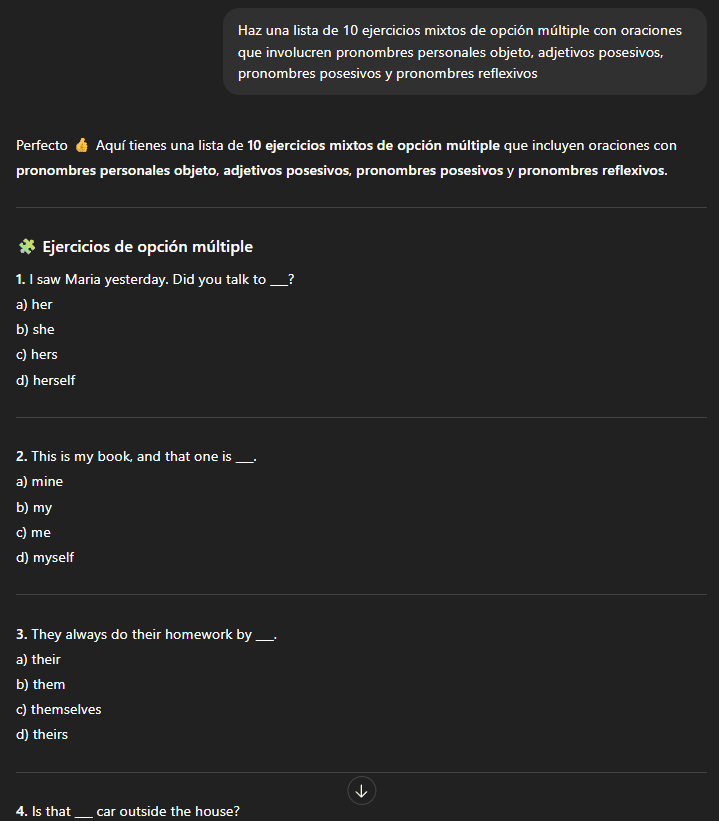
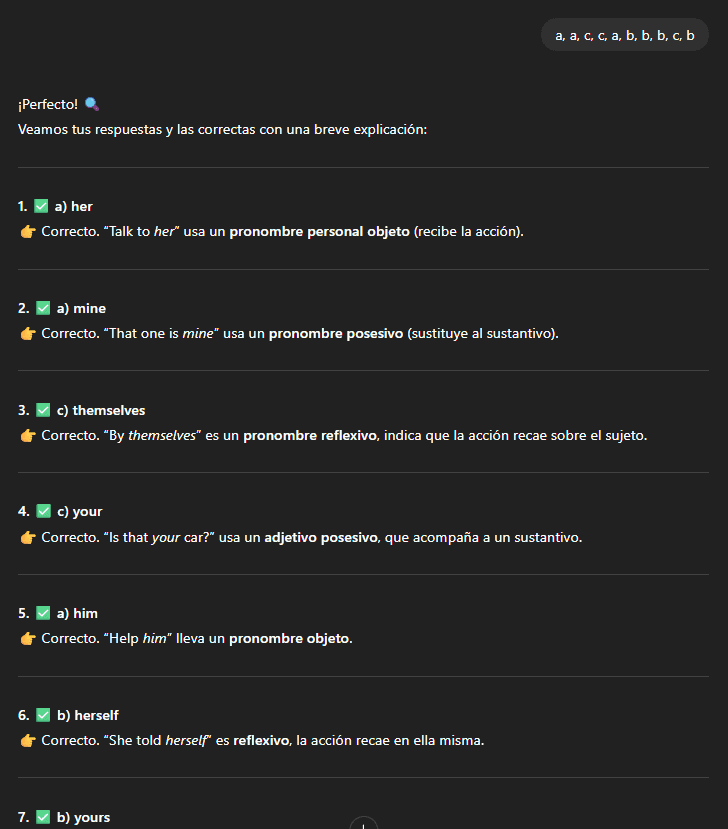
Once you complete the exercises, ask for more and repeat them until you can consistently solve them correctly.
Remember that AI is a tool, and as such, it can still make mistakes. Don't be afraid to question it, ask questions, or correct it: it won't take it personally. Knowledge is free.
Introduction to Verb Tenses
In English, verb tenses indicate when the action occurs (present, past or future) and how it develops (whether it is a simple, continuous or perfect action).
Here's an overview of the three main types:
Simple Tenses
They are made up of a single verb, and in some cases, an auxiliary verb.
Example: I walk.
Continuous Tenses
They are formed with the verb "to be" (corresponding to Spanish "estar" here) plus the main verb in its -ing form.
Example: I'm walking.
Perfect Tenses
They are formed with the verb "to have" (corresponding to Spanish "haber" here) plus the main verb in its past participle form.
Example: I've walked.
Auxiliary Verbs in Simple Tenses
When we talk about auxiliary verbs in the simple tenses, we are mainly referring to "do" and its conjugations "does" (present) and "did" (past).
These are used to form negative and interrogative sentences.
Simple Tenses
The simple tenses are divided into present, past, future, and conditional, and each of them can be expressed in affirmative, negative and interrogative form.
Simple Present
- Affirmative: I walk
- Negative: I don't walk
- Interrogative: Do I walk?
Simple Past
- Affirmative: I was walking
- Negative: I wasn't walking
- Interrogative: Was I walking?
Simple Future
- Affirmative: I'll walk
- Negative: I won't walk
- Interrogative: Will I walk?
Simple Conditional
- Affirmative: I'd walk
- Negative: I wouldn't walk
- Interrogative: Would I walk?
Continuous Tenses
Continuous tenses are divided into present, past, future, and conditional, and each one has affirmative, negative and interrogative forms.
Structure
Continuous tenses are formed with:
- The conjugated form of the verb "to be" ("estar" in Spanish)
- The main verb in its -ing form
Present Continuous
- Affirmative: I'm walking
- Negative: I'm not walking
- Interrogative: Am I walking?
Past Continuous
- Affirmative: I was walking
- Negative: I wasn't walking
- Interrogative: Was I walking?
Future Continuous
- Affirmative: I'll be walking
- Negative: I won't be walking
- Interrogative: Will I be walking?
Conditional Continuous
- Affirmative: I'd be walking
- Negative: I wouldn't be walking
- Interrogative: Would I be walking?
Perfect Tenses
Perfect tenses are divided into present, past, future, and conditional, and each one has affirmative, negative and interrogative forms.
Structure
They are formed with:
- The conjugated form of the verb to have ("haber" in Spanish)
- The main verb in its past participle form
Present Perfect
- Affirmative: I've walked
- Negative: I haven't walked
- Interrogative: Have I walked?
Past Perfect
- Affirmative: I had walked
- Negative: I hadn't walked
- Interrogative: Had I walked?
Future Perfect
- Affirmative: I'll have walked
- Negative: I won't have walked
- Interrogative: Will I have walked?
Conditional Perfect
- Affirmative: I would have walked
- Negative: I wouldn't have walked
- Interrogative: Would I have walked?
The verb "to be"
The verb to be corresponds to both "ser" and "estar" in Spanish.
It is used to describe characteristics, states, identities, professions, places and more.
Affirmative Form
| Spanish meaning | Full form | Contracted form |
|---|---|---|
| Yo soy / Yo estoy | I am | I'm |
| Tú eres / Tú estás | You are | You're |
| Él es / Él está | He is | He's |
| Ella es / Ella está | She is | She's |
| Ello es / Ello está | It is | It's |
| Nosotros somos / Nosotros estamos | We are | We're |
| Ustedes son / Ustedes están | You are | You're |
| Ellos son / Ellos están | They are | They're |
Negative formation
| Spanish meaning | Full form | Contracted form |
|---|---|---|
| Yo no soy / Yo no estoy | I am not | I'm not |
| Tú no eres / Tú no estás | You are not | You aren't |
| Él no es / Él no está | He is not | He isn't |
| Ella no es / Ella no está | She is not | She isn't |
| Ello no es / Ello no está | It is not | It isn't |
| Nosotros no somos / No estamos | We are not | We aren't |
| Ustedes no son / No están | You are not | You aren't |
| Ellos no son / No están | They are not | They aren't |
Interrogative Form
(It has no contraction)
| Spanish meaning | Full form |
|---|---|
| ¿Soy yo? / ¿Estoy yo? | Am I? |
| ¿Eres tú? / ¿Estás tú? | Are you? |
| ¿Es él? / ¿Está él? | Is he? |
| ¿Es ella? / ¿Está ella? | Is she? |
| ¿Es ello? / ¿Está ello? | Is it? |
| ¿Somos nosotros? / ¿Estamos nosotros? | Are we? |
| ¿Son ustedes? / ¿Están ustedes? | Are you? |
| ¿Son ellos? / ¿Están ellos? | Are they? |
Exercises
🔗 Exercises: 'To be' - Simple present
The verb "to have"
The verb to have corresponds to "tener" and "haber" in Spanish.
It is used to express possession ("tener") and to form the perfect tenses in English ("haber").
Affirmative Form
| Spanish meaning | Full form | Contracted form |
|---|---|---|
| Yo tengo / Yo he | I have | I've |
| Tú tienes / Tú has | You have | You've |
| Él tiene / Él ha | He has | He's |
| Ella tiene / Ella ha | She has | She's |
| Ello tiene / Ello ha | It has | It's |
| Nosotros tenemos / Nosotros hemos | We have | We've |
| Ustedes tienen / Ustedes han | You have | You've |
| Ellos tienen / Ellos han | They have | They've |
Negative formation
| Spanish meaning | Full form | Contracted form |
|---|---|---|
| Yo no tengo / Yo no he | I have not | I haven't |
| Tú no tienes / Tú no ha | You have not | You haven't |
| Él no tiene / Él no ha | He has not | He hasn't |
| Ella no tiene / Ella no ha | She has not | She hasn't |
| Ello no tiene / Ello no ha | It has not | It hasn't |
| Nosotros no tenemos / No hemos | We have not | We haven't |
| Ustedes no tienen / No han | You have not | You haven't |
| Ellos no tienen / No han | They have not | They haven't |
Interrogative form
(It has no contraction)
| Spanish meaning | Full form |
|---|---|
| ¿Tengo yo? / ¿He yo? | Have I? |
| ¿Tienes tú? / ¿Has tú? | Have you? |
| ¿Tiene él? / ¿Ha él? | Has he? |
| ¿Tiene ella? / ¿Ha ella | Has she? |
| ¿Tiene ello? / ¿Ha ello? | Has it? |
| ¿Tenemos nosotros? / ¿Hemos nosotros? | Have we? |
| ¿Tienen ustedes? / ¿Han ustedes? | Have you? |
| ¿Tienen ellos? / ¿Han ellos? | Have they? |
Important Note
The conjugation we have just seen is the one used for the perfect tenses in English (present perfect, past perfect, future perfect, etc.).
However, the conjugation of "to have" to express "tener" in the sense of everyday possession is explained in the next section.
Other verbs
For all verbs except modal verbs (can, could, must, have to, might, may, should), these rules apply.
We will use the verb to walk (caminar) as an example.
Affirmative form
(It has no contraction)
| Spanish meaning | Full form |
|---|---|
| Yo camino | I walk |
| Tú caminas | You walk |
| Él camina | He walks |
| Ella camina | She walks |
| Ello camina | It walks |
| Nosotros caminamos | We walk |
| Ustedes caminan | You walk |
| Ellos caminan | They walk |
Negative form
| Spanish meaning | Full form | Contracted form |
|---|---|---|
| Yo no camino | I do not walk | I don't walk |
| Tú no caminas | You do not walk | You don't walk |
| Él no camina | He does not walk | He doesn't walk |
| Ella no camina | She does not walk | She doesn't walk |
| Ello no camina | It does not walk | It doesn't walk |
| Nosotros no caminamos | We do not walk | We don't walk |
| Ustedes no caminan | You do not walk | You don't walk |
| Ellos no caminan | They do not walk | They don't walk |
Interrogative form
(It has no contraction)
| Spanish meaning | Full form |
|---|---|
| ¿Camino yo? | Do I walk? |
| ¿Caminas tú? | Do you walk? |
| ¿Camina él? | Does he walk? |
| ¿Camina ella? | Does she walk? |
| ¿Camina ello? | Does it walk? |
| ¿Caminamos nosotros? | Do we walk? |
| ¿Caminan ustedes? | Do you walk? |
| ¿Caminan ellos? | Do they walk? |
Exercises
🔗 Exercises of Simple present affirmative with 'To have'
🔗Verb "To have" - Exercises - English A1
Glossary
Consonant
They are alphabet sounds that are pronounced by blocking the air with the tongue, lips, or teeth.
- Examples: B, C, D, F, G, H, J, K, L, M...
Vowel
These are sounds that are produced by letting the air out freely, without blocking it.
- In English (and Spanish) they are: A, E, I, O, U
Noun
It is a word that names a person, place, thing or idea.
- Examples: dog, teacher, city, love
Pronoun
It is a word that replaces a noun so as not to repeat it.
- Examples: he, she, it, we, they
Prompt
A prompt is an instruction, order, or input given to an AI tool to generate a response.
Author's Note
Writing this grammar compilation has been very rewarding for me. However, for several reasons, it is currently very difficult for me to keep up with five topics a week. I'm putting this post on hold for now (June 2026), as my time and attention are focused on other projects. I will still gradually review what has already been covered and try to improve how the information is organized and make it more accessible, using tools such as diagrams, tables and text-to-speech.
Also, I hope to return to this post toward the end of this year. Once I finish it, I plan to start a new one focused on algebra and calculus.